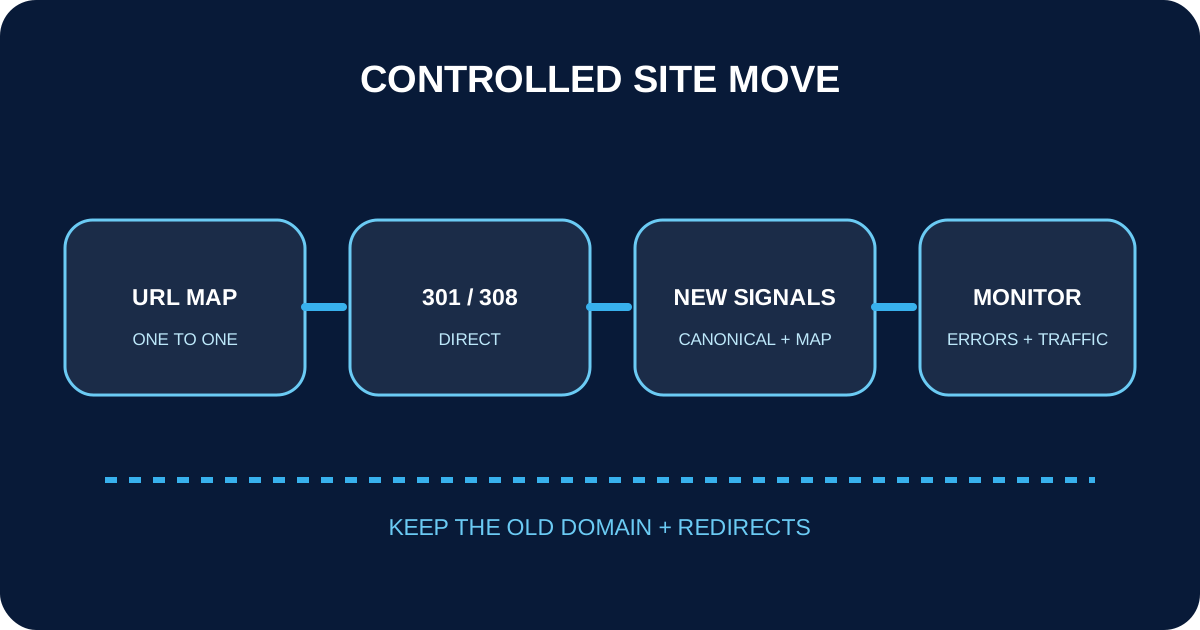
No migration can promise zero fluctuation, but disciplined preparation prevents avoidable loss. Google recommends permanent server-side redirects, updated internal signals and ongoing monitoring while old and new URLs are recrawled.
Build the migration inventory
Crawl the current site, export sitemap and analytics URLs, and collect important backlinks. Map every valuable old URL to the closest equivalent new URL. Fix broken pages before migration rather than copying defects.
- Verify both properties in Search Console.
- Preserve page intent and content where possible.
- Test the new site behind controlled access.
Launch with direct permanent redirects
Use server-side 301 or 308 redirects from each old URL to its final destination. Update internal links, canonicals, hreflang, structured data and sitemaps so they reference new URLs directly.
- Avoid redirect chains and mass redirects to home.
- Keep HTTPS valid on both domains.
- Do not leave accidental noindex rules on the new site.
Monitor and retain the safety net
Submit the new sitemap, inspect representative URLs and watch crawl errors, traffic, conversion and server capacity. Keep redirects for at least the period recommended by current search documentation; Google currently advises generally at least one year.
- Compare old and new URL traffic.
- Update high-value external links where possible.
- Retain ownership and renewal of the old domain.
Official references
Frequently asked questions
Will rankings fluctuate after a domain move?
They can while search systems recrawl and process the mapping. Accurate redirects and signals reduce avoidable disruption but do not guarantee a flat line.
Can every old URL redirect to the new homepage?
No. Redirect each URL to a relevant equivalent; irrelevant mass redirects may be treated like soft errors and frustrate users.
How long should redirects stay?
Follow current search-engine guidance and user needs. Google currently recommends generally at least one year, and keeping useful redirects longer can help users.